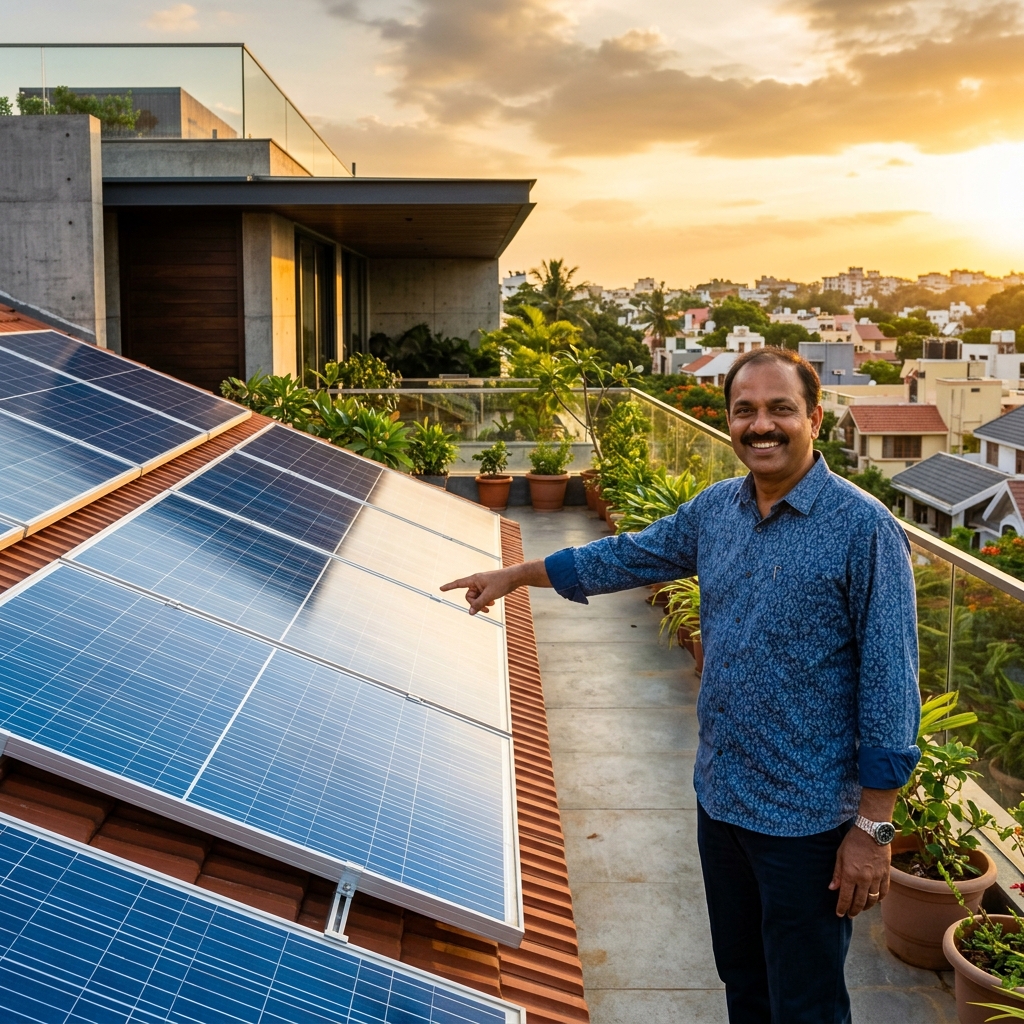
Go Solar with Confidence

Learn myths, subsidies, buying tips & installation process for rooftop solar in India. Empowering your switch to clean energy.

90%Save on Bills
₹78,000Govt Subsidy
25+ YrsSystem Life
Solar Rooftop Installation
verifiedVerified Dealers

Access 100+ top-rated solar installers across India.

Curated Library

Your Complete Solar Guide

Everything you need to know about transitioning to rooftop solar energy, structured for clarity and speed.

lightbulb

Myths vs Facts

Debunking common misconceptions about solar efficiency, costs, and weather performance.

Explore Myths arrow_forward
gavel

Policies

Stay updated with PM Surya Ghar Yojana and State specific incentives.

north_east
shopping_cart

Buying Guide

Step-by-step framework to choose the right system and vendor.

Read Guide arrow_forward
construction

Installation Process

From site assessment to grid connection and subsidy transfer.

See Timeline
Worker installing panel
Education

Myths vs Facts

We're clearing the air. Don't let outdated information stop you from embracing the future of energy.

trending_down70-90% Bill Reduction

Average savings reported by residential users after moving to rooftop solar.

home_workIncreased Property Value

Solar-equipped homes consistently command higher premiums in the real estate market.

Myth: Solar panels are too expensive

verified_user

Fact: With PM Surya Ghar Yojana, you get up to ₹78,000 subsidy, bringing cost down by 40-60%. Payback is just 3-4 years.

Myth: Solar doesn't work on cloudy days

verified_user

Fact: Solar panels work on light, not just direct heat. While efficiency drops, they still produce significant power during monsoon.

Myth: Maintenance is a nightmare

verified_user

Fact: Solar panels have no moving parts. A simple water cleaning once a month is all it takes for peak performance.

Government Benefits

Subsidies & Policies

The government is heavily incentivizing solar adoption. Check your state-specific benefits below.

Featured Policy

PM Surya Ghar: Muft Bijli Yojana

  • verified_user₹30,000 subsidy for 1kW systems
  • verified_user₹60,000 subsidy for 2kW systems
  • verified_userUp to ₹78,000 for 3kW or higher systems
  • verified_userAvailable to 1 crore households across India

Why solar now?

The current subsidy structure is the most aggressive in Indian history. Combined with decreasing panel costs, the ROI has reached an all-time high of 28-32% annually.

Process Matrix

8 Steps to a Solar Home

Our transparent installation framework ensures your system lasts at least 25 years with perfect efficiency.

Technical Assessment

Our engineer visits to check roof health, shadow points, and wiring feasibility.

1

Feasibility Report

Receive a detailed proposal with projected generation and exact ROI breakdown.

2

On-site Installation

High-quality installation of panels, inverters, and structures (2nd stage).

3

Net Metering

Commissioning of bi-directional meter with the electricity department.

4

Ready to switch to
Permanent Savings?

Join 15,000+ happy families who have already switched to Solar Urja. Start saving today.

Knowledge Base

Rooftop Solar Subsidy FAQs

Understand government schemes, subsidy benefits, and eligibility for solar in India

The Government of India provides financial assistance for residential rooftop solar systems under the PM Surya Ghar Muft Bijli Yojana. Homeowners can receive subsidies of up to ₹78,000 based on system capacity. The amount is transferred directly to the beneficiary’s bank account after installation and verification.
Subsidy depends on system size: ₹30,000 for 1 kW, ₹60,000 for 2 kW, and up to ₹78,000 for 3 kW rooftop solar systems. The subsidy is provided via Direct Benefit Transfer (DBT).
States such as Gujarat, Maharashtra, Tamil Nadu, and Uttar Pradesh offer some of the highest incentives by combining central subsidies, state benefits, and net metering policies.
Yes, under the PM-KUSUM scheme, farmers can receive 60–90% subsidy for solar irrigation pumps, helping reduce dependency on diesel and electricity.
Net metering allows users to export excess solar electricity to the grid and receive credits on their electricity bills, reducing overall costs.
A 1 kW system generates approximately 4–5 units per day, while a 3 kW system can generate around 360–450 units per month depending on sunlight conditions.
Residential consumers with a valid electricity connection are eligible. The system must be installed through empanelled vendors registered on the national solar portal.
Installation typically takes 1–3 days. The full process including approvals and net metering may take 2–4 weeks depending on the state DISCOM.
Approximate costs before subsidy: ₹45,000–₹60,000 for 1 kW, ₹1.5–₹1.8 lakh for 3 kW, and ₹2.5–₹3 lakh for 5 kW systems. Subsidies significantly reduce the final cost.
Yes, solar systems typically offer ROI within 4–6 years. After that, electricity generated is essentially free for 20–25 years.
Yes, they can use group net metering or virtual net metering to share benefits among multiple residents.
Required documents include electricity bill, Aadhaar/ID proof, bank details, property ownership proof, and application via the National Rooftop Solar Portal.
Yes, commercial and industrial buildings can install solar systems. While subsidies mainly apply to residential users, businesses benefit through reduced electricity costs and tax advantages.
Solar panels typically last 25–30 years. Inverters may need replacement after 8–12 years.

Still confused about solar subsidy?

Talk to an Expert